Leave Your Message
0%

Picking out Tool Storage Cabinets isn’t just about grabbing the biggest steel box you can find. It’s a real workplace decision—one that touches safety, accessibility, durability, and what it’ll cost you over the long haul. If a cabinet sits beside a production line, it needs to open smoothly, handle repeated loading, and keep sharp tools visible without turning the area into a mess.

And honestly, industry research backs up that practical concern. Grand View Research’s Tool Storage Products Market report points to steady market growth, fueled by professional workshops, manufacturing facilities, and even organized home garages. Fortune Business Insights also notes rising demand for industrial storage cabinets, especially ones with stronger security, modular layouts, and smarter use of space. So yeah—buyers are investing in organization, not just more storage capacity.

Hiroyuki Hirano, author of 5S for Operators, offers a principle worth keeping in mind: “A place for everything, and everything in its place.” Sounds easy, right? It isn’t. The best Tool Storage Cabinets should fit the tools, the workflow, and the working environment. A mechanic might need shallow drawers for sockets and deeper compartments for power equipment. A factory might need lockable doors, corrosion-resistant finishes, and clearly labeled sections.

So look closely at the small details. Can the drawers actually carry their rated load? Do the casters lock firmly on a concrete floor? Will the key system still feel reliable after years of use? Some product descriptions make big promises, but real-world performance can be all over the place. That’s why it pays to compare tested specs, warranty terms, user feedback, and after-sales support before you buy. A cabinet that looks efficient might still waste time if its layout ignores the people who have to use it every day.
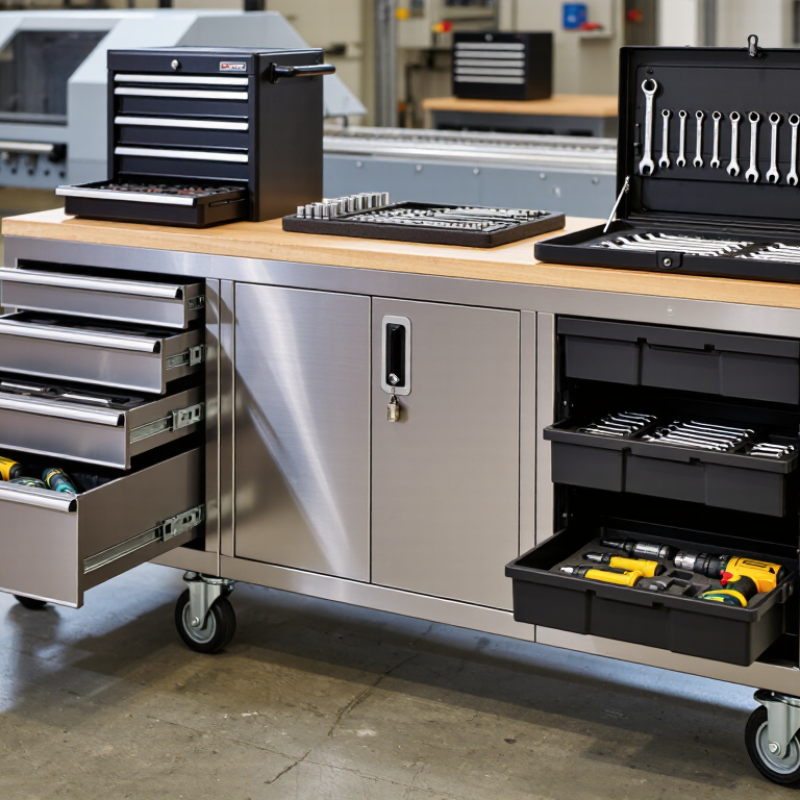
How to Choose the Best Tool Storage Cabinets?

Define Your Tool Storage Needs and Workspace Requirements

Choosing the best tool storage cabinet starts with your work, not the cabinet’s appearance. List the tools you use daily, weekly, and occasionally. Measure their dimensions, weights, and handle lengths. Include power cords, calibration devices, and replacement parts. Small details matter.

Your workspace should guide the cabinet’s size and position. Measure wall clearance, aisle width, ceiling height, and door swing. Keep frequently used tools between knee and shoulder height. This reduces bending, reaching, and unnecessary movement.

The NIOSH Revised Lifting Equation supports evaluating load weight, reach distance, frequency, and handling position. A cabinet that blocks a walking route is poorly planned, even when it has excellent capacity.

The U.S. Bureau of Labor Statistics recorded 888,220 sprains, strains, and tears

involving days away, restriction, or transfer in 2022.

Storage design cannot prevent every injury, but it can remove avoidable reaching and lifting.

Think in zones. Put inspection tools near the workbench, heavy equipment in low drawers, and sharp-edged items in secured compartments.

Label locations with simple words or silhouettes. OSHA 29 CFR 1910.176 requires stored materials to remain secure and avoid creating hazards.

Locking drawers may protect valuable equipment, but they can slow emergency access. That trade-off deserves a real trial.

A larger cabinet may seem efficient. It can also become a drawer for forgotten tools.

Test one layout for a week, record wasted steps, and revise it. Perfect planning is unlikely. Practical adjustment is better.

Compare Cabinet Types, Sizes, and Storage Configurations

Choosing the best tool storage cabinet starts with comparing cabinet types, not chasing the largest option. Garage Tool Storage Cabinets usually fall into three practical groups: freestanding units, rolling cabinets, and wall-mounted cabinets. Freestanding models hold heavier equipment and suit fixed work areas. Rolling cabinets improve flexibility when tools must move between benches or vehicles. Wall-mounted cabinets save floor space, but they need secure installation and careful weight control.

Size should match both your tools and your working habits. Measure the available wall length, ceiling height, door clearance, and walking space before buying. A narrow cabinet may fit beside a workbench, while a deeper unit can store power tools, containers, and spare parts. Drawers are useful for sockets, screws, and measuring tools. Adjustable shelves handle drills, boxes, and irregular equipment. Lockable compartments add control in shared spaces.

I once selected a cabinet mainly for drawer capacity. It looked efficient, but the deep drawers became cluttered quickly. That choice was not perfect. Separate shallow drawers for small tools and taller shelves for bulky equipment would have worked better. Check drawer load ratings, steel thickness, hinge quality, ventilation, and surface protection. A cabinet that opens smoothly after years of dust is more valuable than one that only looks impressive on delivery day. Leave some unused space. It makes future changes easier.

How to Choose the Best Tool Storage Cabinets?

Compare representative cabinet types by external storage volume. Dimensions are shown as W × D × H and converted from common inch-based cabinet formats; actual capacities vary by drawer layout, shelf spacing, and construction.

Tall cabinets provide the greatest overall volume for bulky tools and equipment. Rolling base cabinets offer a balance of mobility and drawer access, while wall-mounted cabinets save floor space and suit smaller, frequently used tools. Modular drawer banks are useful when organized, compartmentalized storage is more important than maximum volume.

Evaluate Materials, Construction Quality, and Weight Capacity

Choosing Garage Tool Cabinets starts with the steel, not the paint. The World Steel Association reported about 1.89 billion tonnes of crude steel production in 2023, showing steel remains a major industrial material. However, a thick-looking cabinet may still use thin sheet metal. Check the gauge, folded edges, weld consistency, and corrosion protection. ASTM A1008/A1008M specifications can help buyers identify suitable cold-rolled steel grades. A smooth powder-coated surface is useful, but it cannot repair weak joints.

Weight capacity needs closer attention. Read the rating for each shelf and drawer, not only the cabinet’s total rating. ANSI/BIFMA X5.9-2019 includes static-load and durability testing principles for storage units, offering a useful comparison point. In practice, store dense items such as sockets and drills near the bottom. Keep routine loads around 70% to 80% of the stated limit. That margin reduces drawer deflection and caster strain. Small details matter.

Construction quality becomes obvious after repeated use. Pull each drawer fully open and check whether the slides remain level. Test the lock, handle, wheel brakes, and anti-tip mechanism. A cabinet that rocks on a smooth garage floor deserves caution. I have learned that attractive drawers can hide weak runners. I still inspect the underside, where manufacturers often save material. Measure the loaded cabinet’s footprint before buying; a narrow, tall unit may tip more easily when a top drawer is open.

Check Security Features, Mobility, and Accessibility

How to Choose the Best Tool Storage Cabinets?

Check Security Features, Mobility, and Accessibility

Security and Storage Protection

A reliable tool storage cabinet should protect equipment from dust, accidental access, and everyday impact. Look for reinforced doors, strong hinges, and a lock that closes smoothly. A useful cabinet also keeps drawers from opening during movement. That detail matters when tools are stored near busy work areas. I once chose a cabinet based only on drawer capacity. The lock felt weak, and the shallow drawers wasted vertical space. That experience changed how I compare storage systems.

Mobility and Accessibility

Mobility needs equal attention. Choose heavy-duty casters with brakes, especially if the cabinet moves across concrete floors. Test the handle height and turning radius before buying. A wide cabinet may hold more tools but become difficult to steer. Accessibility is not just convenience. Clearly labeled drawers, full-extension slides, and visible tool outlines reduce searching time. Keep frequently used tools between waist and shoulder height. Deep drawers should hold heavier items lower down. Even experienced users sometimes ignore this balance.

Tips: Open every drawer before purchase. Check for wobbling, sharp edges, and difficult latches. Measure doorways, workbenches, and storage corners. Leave enough space to stand comfortably. Consider adding drawer liners, but confirm they will not block smooth movement. Review the cabinet after several weeks of use. Your original layout may need adjustment.

Assess Organization Options and Compatibility With Your Tools

Choosing the right tool storage cabinet starts with understanding how your tools are used, not just how much they cost. A cabinet with shallow drawers suits hand tools, while deeper compartments hold drills, sanders, and boxed equipment. Adjustable shelves can accommodate changing collections. Fixed shelves may feel stable, but they often waste vertical space.

In my workshop, I once selected a cabinet with attractive deep drawers. It looked efficient, yet small screwdrivers disappeared inside them. That choice taught me to measure both tool size and reach frequency. A good cabinet should place daily tools near waist level and heavier equipment lower down. Check drawer load ratings, locking movement, handle clearance, and wheel stability. Garage Tool Box Cabinets should also fit your available wall space and allow doors or drawers to open fully.

Tips: Group tools by task, then test the layout before buying. Use drawer liners to reduce sliding and noise. Leave a little empty space for future tools. It is tempting to fill every compartment, but crowded storage slows work. Measure your largest case, power cord, and protective gear. Compatibility includes more than dimensions. Consider electrical access, ventilation needs, and whether the cabinet can support your working habits. A perfect layout rarely appears immediately. Recheck it after a week of real use.

Compare Installation Needs, Maintenance, and Overall Value

Choosing the best Tool Chests And Cabinets begins with the installation site, not the product photo. Measure wall clearance, door swings, floor strength, and access routes before ordering. A cabinet that fits the workshop may fail at the doorway. I once underestimated a narrow corner and had to reposition an entire workbench. That mistake was avoidable.

Installation needs vary by design. Freestanding cabinets offer flexibility, while wall-mounted units save floor space but require strong anchors. Check the fasteners, mounting surface, and loaded weight. Uneven floors may need adjustable feet. Small details matter. Leave room for drawers to open fully. Crowded aisles reduce safe movement and slow daily work.

Maintenance affects long-term value more than the initial price. Look for durable finishes, replaceable drawer slides, reliable locks, and smooth surfaces that wipe clean. Inspect casters, hinges, and fasteners every few months. Remove metal dust before it reaches moving parts. A cheap cabinet can become expensive when repairs are difficult. Still, the most expensive option is not automatically the best. Compare capacity, service access, warranty terms, and expected working life. I would also question unused features; extra compartments can create clutter instead of efficiency. Track how often each drawer is used for a month before choosing a final layout.

How to Choose the Best Tool Storage Cabinets? — Compare Installation Needs, Maintenance, and Overall Value

Cabinet Type Best Use Case Typical Installation Needs Typical Capacity and Load Maintenance Requirements Security and Safety Space Efficiency Indicative Initial Cost Overall Value
Freestanding Steel Cabinet General workshops, maintenance rooms, garages, and storerooms requiring flexible bulk storage.
  • Level floor required.
  • Anchoring to a wall or floor is recommended, especially for tall cabinets.
  • Allow clearance for doors and drawer operation.
Medium to high capacity
Common widths: 900–1200 mm
Typical shelf load: 50–100 kg per shelf, depending on construction.
Wipe powder-coated surfaces with a damp cloth; remove oil promptly; inspect hinges, locks, shelves, and anchor points annually. Lockable doors are commonly available. Heavy items should be stored on lower shelves to reduce tip-over risk. ★★★★☆
Uses floor space efficiently but requires front access.
Low to medium ★★★★☆
Strong balance of capacity, durability, and purchase cost.
Drawer Tool Cabinet Organized storage for hand tools, measuring equipment, small parts, and frequently accessed items.
  • Place on a level, stable surface.
  • Heavy-duty models may require reinforced flooring.
  • Anti-tip features should be engaged before use.
Medium capacity
Drawers typically support 45–100 kg each, depending on the model and slide system.
Keep drawer slides clean; do not exceed rated loads; lubricate slides only when specified by the manufacturer; inspect casters and drawer latches. Locking systems and anti-tip mechanisms improve security and stability. Open only one heavily loaded drawer at a time unless designed otherwise. ★★★★★
Excellent visibility and access with compact vertical storage.
Medium to high ★★★★★
High productivity value where tool access frequency is high.
Mobile Tool Cabinet Work areas where tools must move between benches, service bays, or production stations.
  • Requires a smooth route and adequate turning clearance.
  • Lock casters before opening drawers.
  • Check ramp gradients and floor transitions before purchase.
Medium to high capacity
Typical total load ratings range from 300–900 kg, depending on size and caster design.
Inspect caster wheels, brakes, handles, drawer slides, and fasteners regularly; clean debris from wheels and keep drawers evenly loaded. Locking drawers and caster brakes help prevent unauthorized access and unintended movement. Avoid pushing with open drawers. ★★★★☆
Flexible, but requires aisle and maneuvering space.
Medium to high ★★★★☆
Worthwhile when mobility reduces walking and retrieval time.
Wall-Mounted Cabinet Small workshops, service rooms, and areas where floor space is limited.
  • Must be fixed to suitable structural material.
  • Verify wall strength, fastener type, and cabinet load rating.
  • Professional installation may be needed for masonry or reinforced walls.
Low to medium capacity
Commonly suited to light and medium tools; capacity is limited by the wall and mounting system.
Clean doors and shelves; check mounting bolts and wall fixings periodically; remove loads before adjusting or relocating the cabinet. Lockable doors protect contents. Do not store heavy tools overhead where frequent handling could create a falling-object hazard. ★★★★★
Preserves floor area and keeps tools above work surfaces.
Low to medium ★★★★☆
Very good value when floor space is more expensive than wall space.
Modular Cabinet System Growing workshops, production areas, and facilities that may need reconfiguration over time.
  • Plan the layout, utility access, and aisle width before installation.
  • Level connected units and anchor tall sections.
  • Assembly time is higher than for a single cabinet.
High and expandable capacity
Capacity varies by combination of base cabinets, wall units, drawers, shelves, and worktops.
Clean shared worktops and cabinet surfaces; inspect connections, leveling feet, drawer slides, and anchors after relocation or layout changes. Lockable modules, reinforced frames, and anti-tip accessories can be selected according to the working environment. ★★★★☆
Efficient when carefully planned; poor layouts can reduce usable aisle space.
High ★★★★★
High long-term value where storage needs are expected to change.
Fire- and Chemical-Resistant Cabinet Storage of flammable liquids, chemicals, or sensitive materials where regulatory controls apply.
  • Installation must follow local fire, safety, and ventilation requirements.
  • Keep away from ignition sources and incompatible materials.
  • Use only for substances permitted by the cabinet certification and design.
Specialized capacity
Common sizes range from small under-counter units to tall cabinets; load is limited by shelves and stored containers.
Inspect doors, self-closing mechanisms, vents, spill-retention sumps, labels, and corrosion; clean spills immediately using approved procedures. Designed to reduce risk, but it does not replace correct labeling, segregation, workplace training, or legally required controls. ★★★☆☆
Uses dedicated floor space but may be essential for compliant storage.
High ★★★★☆
High value when safety compliance and risk reduction are priorities.
Selection guideline: Prioritize installation compatibility first, then load rating, access frequency, security, maintenance effort, and total ownership cost. Indicative capacities and costs vary with material thickness, dimensions, drawer hardware, safety certification, and local installation conditions. Always verify the cabinet’s technical rating and applicable workplace regulations before purchase.

FAQS

How should I determine the right tool cabinet size?

List your daily, weekly, and occasional tools. Measure their length, width, weight, handles, cords, and cases. Leave some empty space. Your collection may grow.

Which tools should go in the most accessible drawers?

Keep daily tools between knee and shoulder height. Place inspection tools near the workbench. Store heavy equipment in lower drawers. This reduces bending and reaching.

How can I organize tools inside the cabinet?

Group tools by task, such as cutting, measuring, or fastening. Use simple labels or silhouettes. Add drawer liners to limit sliding and noise. The layout may need revision.

What should I check before placing a cabinet in my workspace?

Measure wall clearance, aisle width, ceiling height, floor strength, and door swings. Check the delivery path too. A cabinet can fit the room but fail at the doorway.

Are shallow or deep drawers better for tool storage?

Shallow drawers suit screwdrivers, pliers, and small hand tools. Deeper compartments fit drills, sanders, and boxed equipment. Match drawer depth with actual tool sizes. Deep drawers can hide small items.

What safety details should I consider?

Keep sharp-edged items in secured compartments. Make sure the cabinet does not block walking routes. Check wheel stability and loaded weight. Locking drawers improve protection but may slow access.

What installation features are important?

Freestanding cabinets offer flexible placement. Wall-mounted units save floor space but need strong anchors. Check fasteners, mounting surfaces, and loaded weight. Uneven floors may require adjustable feet.

How can I judge long-term value and maintenance?

Look for durable finishes, replaceable drawer slides, reliable locks, and smooth surfaces. Inspect casters, hinges, and fasteners every few months. Remove metal dust from moving parts. Expensive does not always mean better.

Conclusion

Choosing the right tool storage cabinets begins with understanding your workspace, the types of tools you own, and the amount of storage you need. Consider the cabinet’s size, layout, drawer depth, shelving options, and overall configuration to ensure every item has a suitable place. Different cabinet styles may serve compact workshops, large garages, or professional work areas more effectively, so available space and future storage needs should guide your decision.

Pay close attention to materials, construction quality, weight capacity, and the durability of drawers, hinges, and casters. Security features such as locks can help protect valuable equipment, while mobility and easy access improve daily efficiency. Look for organization options that match your tools, including adjustable shelves, dividers, trays, and compatibility with existing storage systems. Finally, compare installation requirements, maintenance needs, warranty coverage, and total cost to determine the best long-term value. A well-chosen cabinet should improve organization, protect tools, and support a safer, more productive workspace.
Alexander

Alexander

Alexander is a dedicated marketing professional with a profound understanding of tool storage solutions and workbench products. Since joining the company, he has played a pivotal role in communicating the brand's core mission: to provide robust and reliable storage for powerful tools. With a......
Previous China Top 10 Garage Tool Box Manufacturers for Importers?